

Cecafé and NCA inform USTR that Brazilian coffee farming combines productive efficiency with environmental preservation
The U.S. government’s unilateral trade action against Brazil, known as the Section 301 investigation, has mobilized the Brazilian coffee supply chain to defend the sector’s sustainability and to call for coffee to be included among the products exempt from the 50% tariff that took effect on August 6.
In a coordinated effort, Brazil’s coffee export sector, represented by Cecafé, and U.S. importers, represented by the NCA, presented technical arguments at a public hearing held by the United States Trade Representative (USTR) in early September as part of the Section 301 investigation.
One of the main allegations raised by the U.S. government against Brazilian agribusiness products is illegal deforestation. To dispel any suspicion of links between Brazilian coffee and deforestation, Cecafé provided strategic information to its U.S. partners to show the USTR that Brazilian coffee farming is science-based and delivers important environmental services.
One of the elements highlighted in the defense is the “land-sparing” effect observed in recent decades.
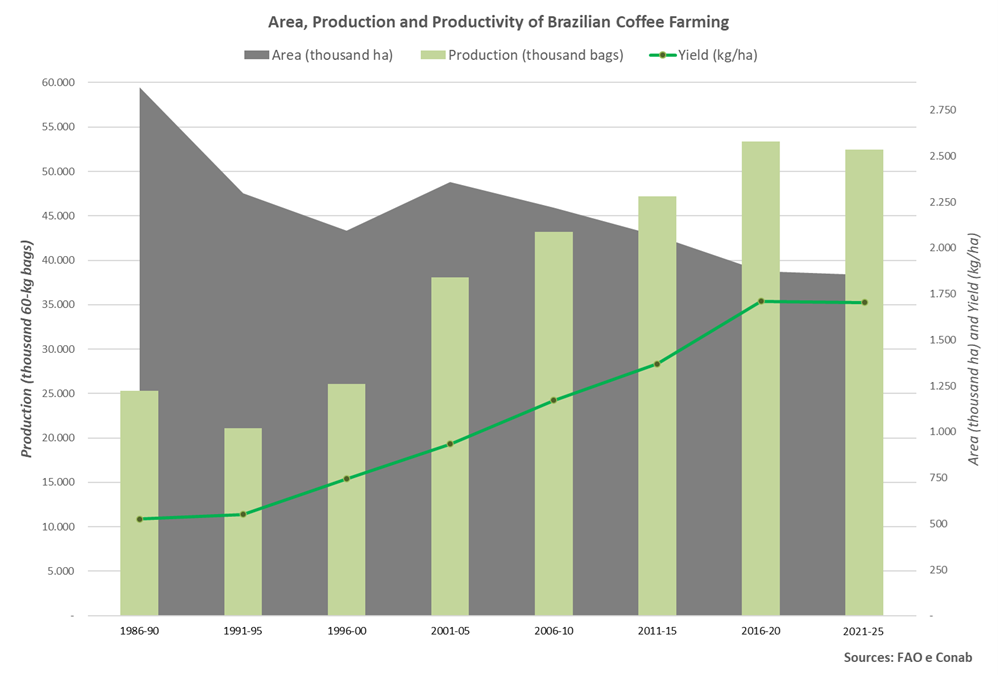
Since the mid-1980s, the area under coffee cultivation in Brazil has declined by 40%, while production has increased by 87%. Investments in genetic improvement and the adoption of good agricultural practices have driven a 130% increase in the productivity of Brazilian coffee farms over this period.
These figures show that the growth of Brazilian coffee production does not rely on expanding cultivated land. Instead, the country remains the world’s leading supplier thanks to steady productivity gains that enable forest preservation within rural properties—an advantage unique to Brazilian agriculture.
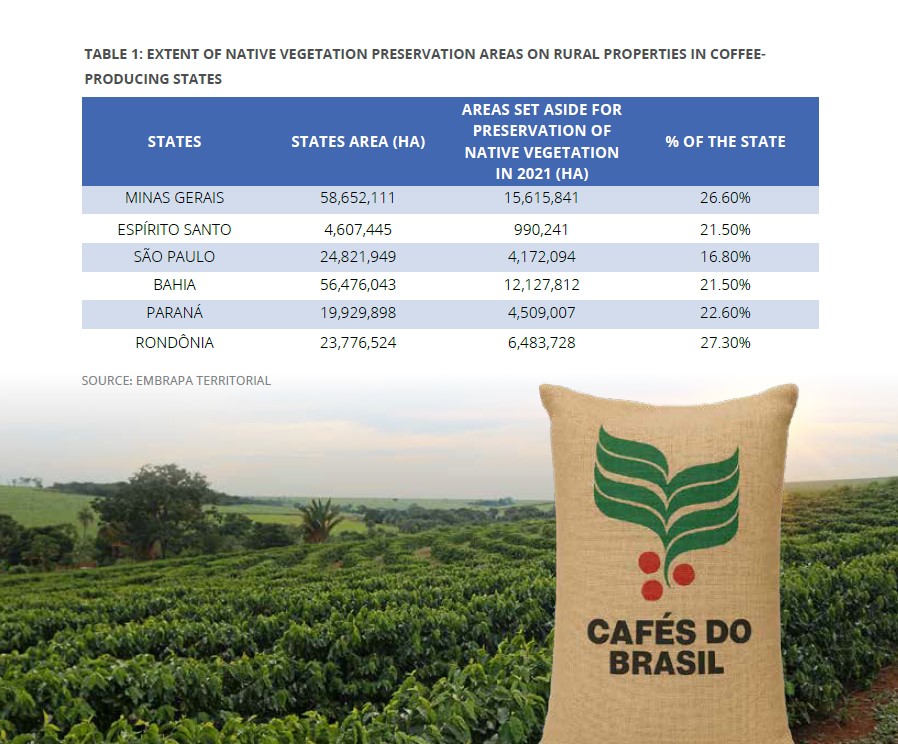
According to a study conducted by Embrapa Territorial, based on data from the Rural Environmental Registry (CAR), 43.9 million hectares of native vegetation are preserved within rural properties in the main coffee-producing states of Brazil. On average, this area accounts for more than 20% of the states’ territories.
The link between coffee farming and forest preservation is also underscored in a study by the Federal University of Minas Gerais (UFMG), which found that 99% of the 115,000 coffee-producing properties in Minas Gerais registered in the CAR showed no significant deforestation after 2008, qualifying the state’s coffee production as a deforestation-free supply chain. In addition, about one-third of coffee-producing rural properties preserve more native vegetation than required by the Forest Code, totaling 302,000 hectares of surplus forest that provide essential ecosystem services to coffee production.
As part of Cecafé’s carbon agenda, studies by Professor Carlos Eduardo Cerri of the University of São Paulo (USP) and Imaflora were also presented to the USTR, measuring the environmental benefits of preserved native vegetation on coffee farms in Minas Gerais and Espírito Santo.
For the farms evaluated in Minas Gerais, an average of 183 t CO₂eq per hectare of coffee are stored in permanent preservation areas and legal reserves. In Espírito Santo, the farms evaluated showed that each hectare of Conilon coffee stores 338.67 t CO₂eq in preserved native vegetation.
In addition, the USTR was briefed on the climate benefits generated by Brazilian coffee produced under good agricultural practices. As identified under Cecafé’s carbon agenda, the adoption of good agricultural practices—such as adding organic matter to the soil, maintaining vegetation cover between coffee rows, and using organomineral fertilizers—enables Arabica coffee farming in Minas Gerais to sequester about 10.5 metric tons of CO₂ equivalent per hectare per year in soil and plants, in addition to what is emitted into the atmosphere.
In Espírito Santo, similar benefits have been observed across different Conilon coffee production systems. When pastureland is converted to conventional coffee farming, the carbon balance is negative by about 3.01 t CO₂eq per hectare per year. This figure falls further, to –8.24 t CO₂eq per hectare per year, when pastureland is converted to sustainable Conilon production systems. In a third production system, shifting from conventional management to the adoption of good practices, the carbon balance also remains negative, at about –1.36 t CO₂eq per hectare per year.
Another advantage of Brazil as a coffee origin is the availability of public databases that enable ongoing monitoring of socio-environmental compliance in all 39 producing regions, whether certified or conventional. As a result, Brazilian coffees are already well positioned to meet the requirements of the European Union Deforestation Regulation (EUDR).
For example, through the Socio-Environmental Monitoring Platform for Coffees of Brazil—an initiative of the export sector—it is possible to generate conclusive, verifiable evidence that coffee was not produced in areas deforested after December 31, 2020, and that production complies
with Brazilian legislation.
These advances reaffirm Brazil’s position as the world leader in sustainable coffee production. According to the Sustainable Coffee Purchases Report of the Global Coffee Platform, Brazil stands out as the leading supplier among the 28 origins included in sustainability scheme purchases equivalent to the Coffee Sustainability Reference Code. The country accounted for 462,979 tons, or 33% of the total sustainable purchases declared by nine companies3, which amounted to 1,391,796 tons.
In light of this evidence, Brazil emerges as an origin with a mature, organized, and transparent supply chain, backed by verifiable sustainability indicators. The country is fully capable of responding swiftly and responsibly to the demands of the U.S. industry, ensuring a sustainable and continuous supply of coffee to U.S. consumers.
(3): JDE Peet’s, Keurig Dr Pepper, Melitta Group, Julius Meinl, Nestlé, SUPRACAFÉ, Tesco, Westrock Coffee Company, and Taylors of Harrogate.
Marcos Matos
CECAFÉ CEO
Silvia Pizzol
CECAFÉ Sustainability Director

Leave A Comment